Making iNaturalist observations was one of the objectives of our Argentina travels. Why was this? It provides a “permanent” record of the location of biota at a moment in time. Such observations help to map the diversity of life on Earth and can, in principle, be used to aid in conservation activities.
The iNaturalist platform can be used to easily see where one’s observations fall – in terms of categories of organisms. For example, how many bird species did we see and how many observations did we make of birds? The same can be asked of any other group of organisms (or any biota). One does this by selecting the “filters” option and putting for location Argentina, the dates of your travel, and the observations by yourself. The image below shows this. Rosario’s iNaturalist account is “argonauta”.
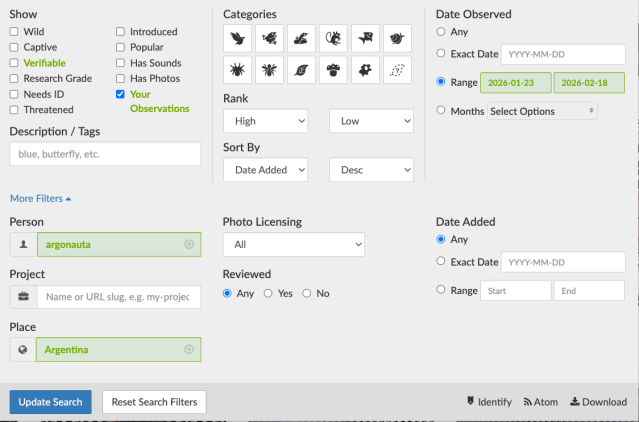
For our recent Argentina trip in 2026 the results can be summed, as mentioned, for any group of biota. Here are the observations and species for some groups of interest (to us):
| Biota | Observations | Species |
| Insects | 1978 | 524 |
| Moths | 1056 | 171 |
| Butterflies | 66 | 39 |
| Beetles | 419 | 132 |
| True Bugs | 226 | 80 |
| Plants | 780 | 333 |
| Bromeliads | 112 | 26 |
| Cacti | 171 | 40 |
| Amphibians | 9 | 3 |
| Reptiles | 5 | 3 |
| Mammals | 21 | 4 |
| Birds | 361 | 131 |
| ALL INATURALIST OBSERVATIONS | 3221 | 1029 |
Although birds are much more conspicuous than other organisms in most environments, they have fewer species than insects, especially moths and beetles. The numbers of species for the insects is currently an underestimate, since many species have not been identified. Of course, there are multiple observations for many organisms since these can be observed in different locations and different times.
The above list is preliminary, as observations are still being added from the trip. But they should give a flavor for the relative abundance and diversity of the various groups. Also, most of these observations (except for birds) do not have confident identification to species (so-called “research grade”). Getting accurate observations sometimes takes years, or never – depending on the quality of the image and what is needed to identify the organism. Most biota get an estimate of what they are from the Artificial Intelligence algorithm that identifies by patterns and structures, but these can be seriously in error for many groups of organisms or plants that have relatively few observations.
 THE NATURALIST'S TRAVEL PAGE