This page is a repository for ideas related to improving IBS interactions with the global community – especially the Global South. Just what is the “Global South” and its history can be be discovered in the interesting article here. The domain of the Global South, according to this author is shown in the image below:
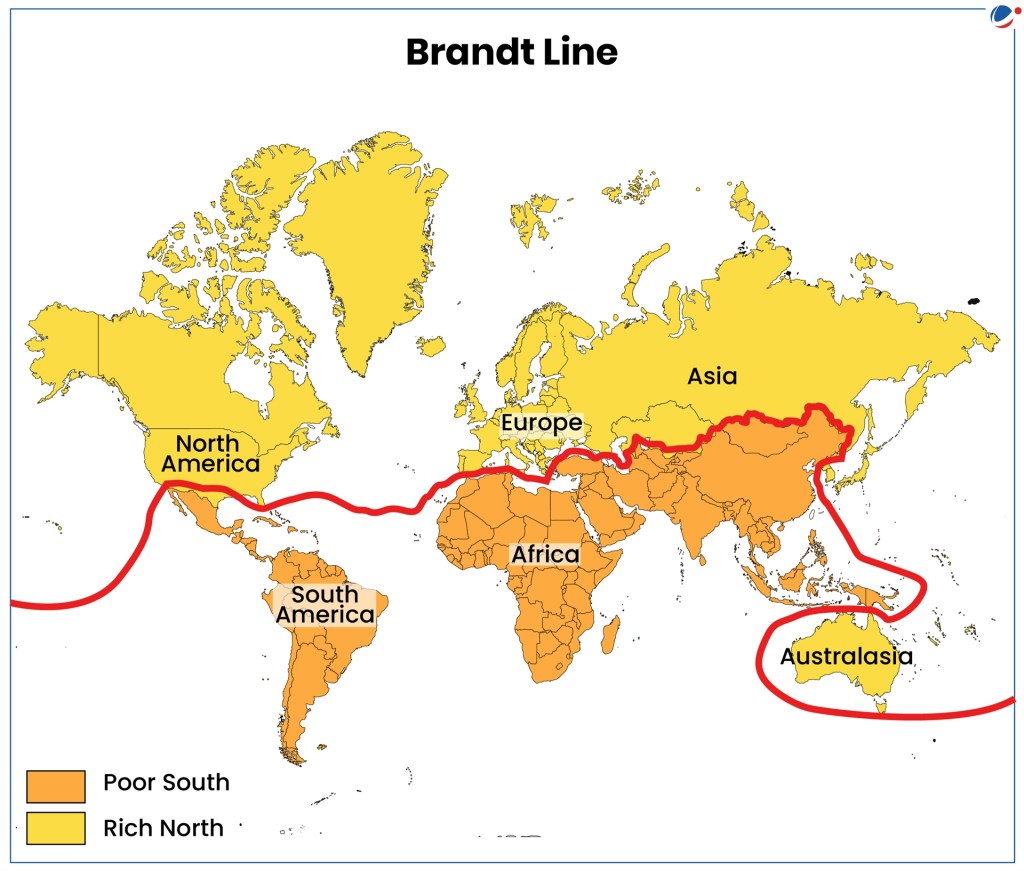
This was perhaps generally valid as a divide between the “rich north” and the “poor south” when it was produced, but some changes have clearly occurred. China has developed rapidly and many middle eastern countries around the Persian Gulf have likewise developed. Often, urban areas in the Global South can be developed in many ways quite similar to the Global North, but the rural areas are decidedly underdeveloped. For the purpose of this discussion, we can consider the Global South as a proxy for somewhat less developed countries that are minor players in many scientific circles.
What can the IBS do to increase its visibility in the Global South?
All of the comments below are my opinions on how to ramp-up interest in biogeography and allied conservation activities in the GS.
I think to succeed in generating more interest in biogeography in the GS one has to recognize that meetings that have a strict focus on biogeography theory are doomed to poor attendance and low impact. Too few people in the GS have this luxury. Funding is scarce for many students, and research that has a clear application to society is preferred. Publications are valuable, but are often more for professional advancement of the researcher than for societal impact.
More meetings in the GS. There are at least three broad regions in the GS – Latin America, Africa and South Asia. To have a meeting in alternate years to the main IBS biennial meeting means that a meeting in a particular GS region (say Africa) would occur only every 6 years. This isn’t frequent enough to maintain personal contacts or develop joint activities.
More frequent meetings in the GS More frequent meeting in the GS are needed. Ideally one each year – in each region – but rotated geographically within the region. For example, in Latin America one might have a meeting in Paraguay one year, followed by a meeting in Venezuela the next year, followed by a meeting in Peru the next year etc. The focus might be slightly different in each meeting, or it might include many topics.
Meetings/workshops in interesting locations and times of year in the GS. To attract interest from students and university faculty some thought needs to be put into places and activities that would interest more people. The IBS workshops being mostly offered in recent conferences are aimed at established researchers, or post-docs and graduate students from the Global North. There has been a lack of interdisciplinary topics or applications to a broader audience. For example, workshop topics that might draw a more diverse audience could be:
1) Biogeography fundamentals for “eco”-tourism operators.
2) Using iNaturalist for developing better observational data.
3) Photographic hardware and techniques for producing quality citizen science data.
4) Employment possibilities for biogeographers within the ecotourism sector
5) Developing educational materials for biogeography education at all levels.
6) Producing videos and webpages to show your work.
7) Developing interdisciplinary backgrounds for biogeography.
8) establishing effective interdisciplinary teams for biogeography work
9) Preparing materials for media distribution
10) Seeking financial support for biogeography research.
11) Biogeography applications to nature conservation
Few of the above topics are discussed in the Biennial IBS meetings or associated workshops. The above topics were just the product of a few minutes thought. There are dozens of other topics.
Most of the above topics are not taught in graduate (or undergraduate) school, and I think few have been offered as workshops at IBS Biennial meetings. Yet they are crucial to transferring information from the scientific realm to the public realm. And science support depends on public awareness and belief in the value of basic and applied science.
Most of the above topics could be aimed at educators, the ecotourism sector, or those involved in nature conservation activities. These are the people that interact most with the public on topics related to biogeography. Would it dilute the focus of the IBS? Possibly. Would this be bad? Not necessarily. Biogeography is perhaps the most interdisciplinary science. Its applicability should also be comparably broad.
Most conferences are carried out in conference centers with rooms capable of handling large plenary sessions. Such facilities are expensive and require substantial registration fees for participants. These fees, along with the travel, lodging and food expenses are typically covered by a research project budget. But this then filters out anyone without financial support for such travel expenses.
If meetings are smaller, hosted by an educational institution that benefits from added visibility, and participants agree to contribute their time (small amount) to running the conference/workshop, then the costs can be lowered. Travel costs will remain, but can be mitigated by dorm rooms and collective meals.
Interesting venues. While field trips and activities outside the conference venue are not strictly critical to a meeting’s formal communication of information, outdoor activities are often the most effect means to develop personal connections among participants. For this to be feasible, a conference venue should have attractions relevant to the conference’s objectives. Virtually all biogeographers have an interest in nature, so field trips to, or activities in, natural environments should be a key component of such meetings. The current IBS biennial meetings, taking place in January, are often poorly suited (e.g. low temperatures, little daylight) to outdoor activities if they take place at higher latitudes.
Given that many participants to such meetings may never have visited the region where the conference is held, and may not return in the near future, some effort needs to be made so that those wishing to learn more about the environments and biota around the conference venue have this opportunity. The IBS Quito meeting in 2019 had several valuable field trips for participants, but given the distance from the home institutions of European conference participants, several additional days of activities might have been welcomed. For busy senior faculty members such time diversions might not be feasible, but for students, additional time spent in such environmental/multidisciplinary activities is probably an excellent investment in their personal development and motivation for further work in the field.
Smaller meetings with more interaction
Smaller meeting are always preferable, but there is a lower limit when too little diversity of backgrounds and perspectives is reached. Perhaps 100 attendees for a regional annual meeting is desirable. Parallel session conferences are almost never ideal since many participants will want to attend more than one session at the same time.
Poster sessions are always a plus, since they allow for one-on-one interactions that aren’t possible in a talk.
National-level meetings and workshops
Travel can be the largest cost (although usually covered by each individual) in running an international workshop, especially if it is less than a week in duration. One way to minimize this is to have national-level workshops, where most participants come from within the host country. This obviously has limitations in the audience that can be reached, but as an example, a workshop held in a border city like Foz de Iguazu, Argentina (or Brazil) would be accessible via ground transport from southern Brazil, Paraguay, and northern Argentina. Even Bolivians and Uruguayans could attend via ground transport, albeit a long one. A meeting near Victoria Falls, Zambia, could be accessible to participants from Botswana, Zambia, Zimbabwe, Namibia and even South Africa. While some of these distances might seem excessive, ground transport is much less expensive than airline fares and sometimes an entire group of students can travel via ground to a workshop for the same cost as flying one student.
To ensure “cross-pollination”, a certain percentage of researchers from other parts of the world would be needed for such regional conferences. Since many researchers in the Global North have research work in, or with GS data, obtaining their attendance at regional meetings should not be a major problem.
Some of my experiences with organizing meetings for the PACS-SONET project
I ran a climate-monitoring program for 9 years using simple pilot balloon observations to measure the lower and mid-tropospheric windfields on a daily basis in Latin American countries where such observations didn’t exist. Effective observations required motivated observers, understanding of what we were measuring, and how their meteorological services might use the observations. To provide the training and motivation to weather service personnel in the countries where we were making the observations, we organized training and education sessions in Panama City, Panama and La Paz, Bolivia. We also had similar, shorter duration sessions elsewhere. These workshops, where I was the only speaker, were three weeks long and involved a short “field experiment” to explore a locally important meteorological phenomenon.
NOAA had research funds available to carry out such workshops – but only with some unconventional cost-saving methods. We could fund only two individuals from each country, but they had to arrive to the workshop and we would cover the hotel costs (that we arranged). A local university provided the venue for the workshop. And more local support came from various sources.
Key to affordability and maximizing participation was our arranging the accommodations and providing a food allowance – that was lower than the normal international per diem rate for food.
While we stated that we had funds for only two individuals from each country to attend the Panama workshop, the selected Colombian participants asked if they could split the funds we were allotting for them in a way that would permit more participants to come. Eventually, through their efforts, and help from within their country, 12 Colombians came! When there is genuine interest, people will find a way to do something.
Something similar happened with our La Paz, Bolivia workshop, with attendees arranging inexpensive accommodations and food, and some traveling by bus from Peru or elsewhere in Bolivia. When such training and education opportunities are scarce, many people will seek them out.
Latin American Biology students organization meeting in Cochabamba, Bolivia
I was invited to present a Conferencia Magistral at a Meeting of Latin America Biology Students in Cochabamba Bolivia in 2017. No travel funds were available, but my wife and I decided it was a good reason to return to Bolivia – especially the opportunity to talk to a large group (perhaps 100+) of biology students. I gave an hour talk to try to encourage the students to do various things, and I also gave a day-long workshop on field photography techniques for biologists.
There were two important items I noticed about the conference. The first was that the vast majority of the students were from Bolivia, with a smaller number from neighboring Peru. Thus, such “Latin American” meetings were really dominated by participants from the host country – due likely to the cost of travel, and for some, possibly the difficulties in obtaining visas.
My photography workshop was well attended – though about half the students could not make the lectures due to a road blockage (protest) from where they were coming from. But the students had arranged a day-long field trip via a rented bus to a cloud forest location to practice field photography. This was their initiative. The field trip turned out to be a valuable experience for the students from different Bolivian universities and one could see that such joint activities were extremely important – yet they were clearly rare.
Every field activity I have been involved with has yielded similar conclusions – the field activities led to closer collaboration among the participants – whether students or researchers.
Although the field activities might have appeared to interfere with the research activities and academic advancement of the participants, it clearly had some longer-term benefits. Participants in these workshops eventually became Directors of the Meteorological Services of Peru, Ecuador, Bolivia, Argentina, Paraguay, and Mexico. Others are at high levels in their respective Met services. And the current Director of the World Meteorological Organization (Celeste Saulo from Argentina) was an active participant in various of our educational/training/research activities. Impact is more than publications…

