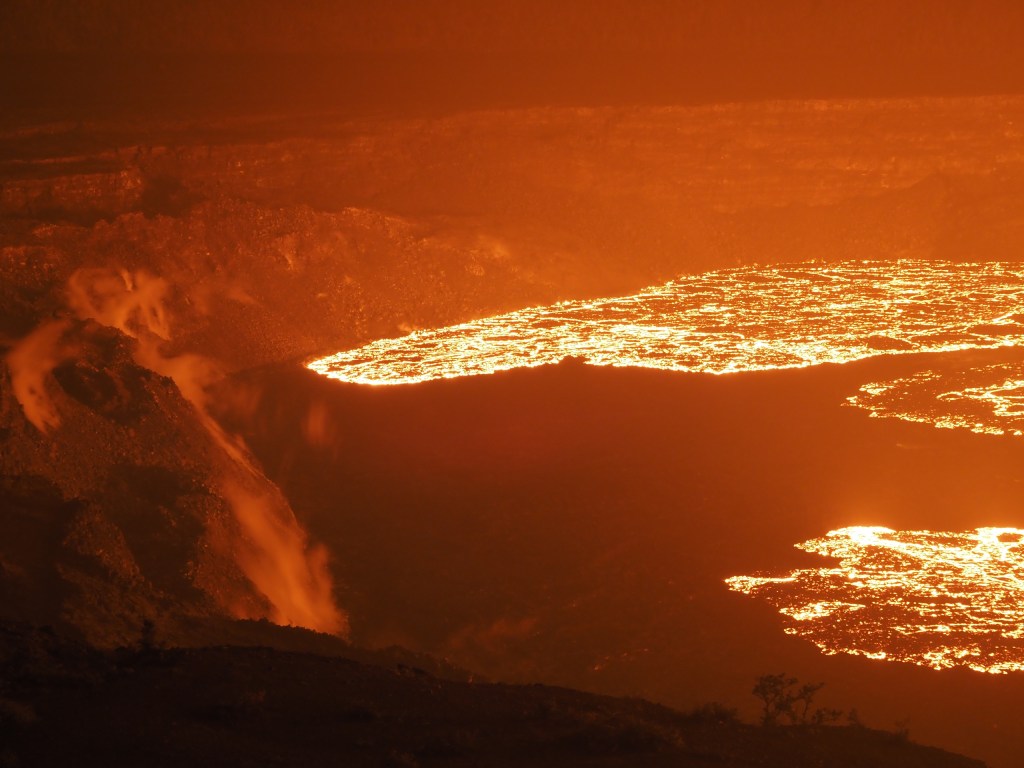
Below are some photos and videos of the Kilauea “fountaining” event on Nov 26 2025. They have been reduced somewhat in size to 1080p for webpage display. I am including below our videos some videos from the US Geological Survey (USGS) webcams that monitor Kilauea. During a Dec 6th eruption one of the cameras was destroyed by falling tephra (ejecta from the volcano of any size). Makes an interesting video. The one basic USGS website related to Kilauea is here. It has links to the USGS webcams and other information about Hawaiian volcanic activity.
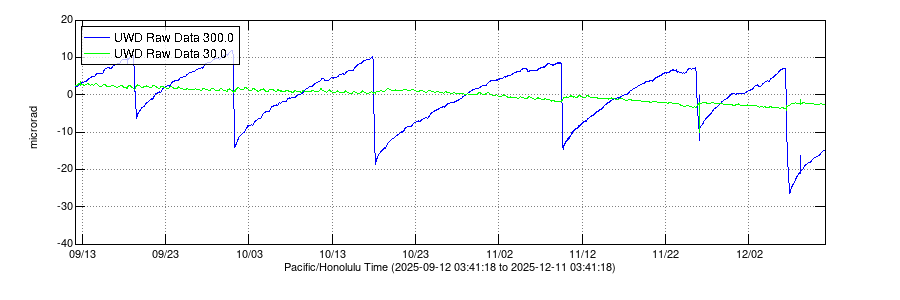
We were lucky to see the fountaining event while staying about 3 miles from the park in Volcano, prior to joining our cruise ship in Honolulu (where I gave talks on the way back to San Diego). The Kilauea volcano has been very active since December 2024, with about 37 fountaining events through December 2025. Even between these events, there have been precursor days with lava flows from the main vents in the western edge of the Halemaumau caldera. This activity is semi-periodic, from the plot of tilt measurements (figs are from the USGS website) made continuously from tiltmeters around to Kilauea. These describe the inflation and rapid deflation of the volcano. Several plots are shown below, with different time axis.
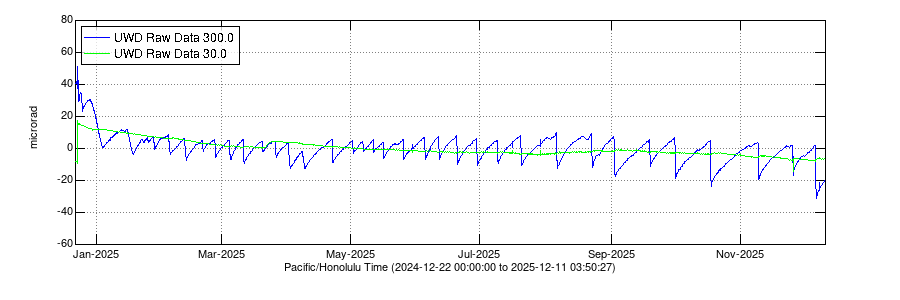
The blue curve in the plot above shows the tilt at one station from late December to late November, while the plot below shows the last 3 months – with 10-day vertical bars. Fountaining events (associated with rapid deflation) occur when the tilt changes very rapidly – these are most obvious in the last 6 months (but the tilt meter orientation was changed slightly to better measure the amplitude of the tilt changes. The plot below shows that when we were there – Nov 21-25, one fountaining event occurred. But the days between the previous event and ours was much shorter, and it was even less between the Nov 25 and Dec 6 events. The “glitch” of the tilt meter data on Nov 25th, near the end of the fountaining, was an earthquake – that we felt in our cabin. It was magnitude 4.8, the strongest on the Big Island in more than 5 years, but was not directly associated with Kilauea’s eruption – it was about 30 km away. Although it is suspiciously close in time… I think too close… to be pure coincidence.
For volcano tourists, even those living on the Hawaiian Islands, precise prediction of fountaining events is not yet possible. Only continuous webcam monitoring would allow for tourists to be able to arrange travel when an eruption was taking place. These fountaining events only last for 4-12 hours, so even those living on the Big Island need to monitor the webcams almost continuously (or get rapid updates from a reliable 24-h source) to be able to make it to the park. An eruption can happen at any hour, and if one occurred at 1 AM and lasted only until 6 AM, it might be very difficult for most people to see it.
We spent about 6 hours observing the fountaining event on the day before we had to fly to Honolulu. The fountaining started around 2:40 in the afternoon of Nov 25th, and I had just started an afternoon nap since we’d been to the park earlier in the day and had just had lunch. I had left the webcam running on my laptop… Fortunately the screen saver didn’t come on and the laptop didn’t go to sleep, and my wife glanced at it before beginning a nap – and she noticed something “different”. She woke me and asked me to look… When I saw the webcam it was obvious that fountaining had started! I checked the older imagery from the webcam (last 10 hours are online) and the fountaining had started only a few minutes earlier. So we rapidly got ready and headed to the park – which from our house in Volcano was only about 3 miles. Lots of people were already there at the first lookout we stopped at – but there was still a few parking slots left. Later there would be cars strung out along the highway for a long distance.
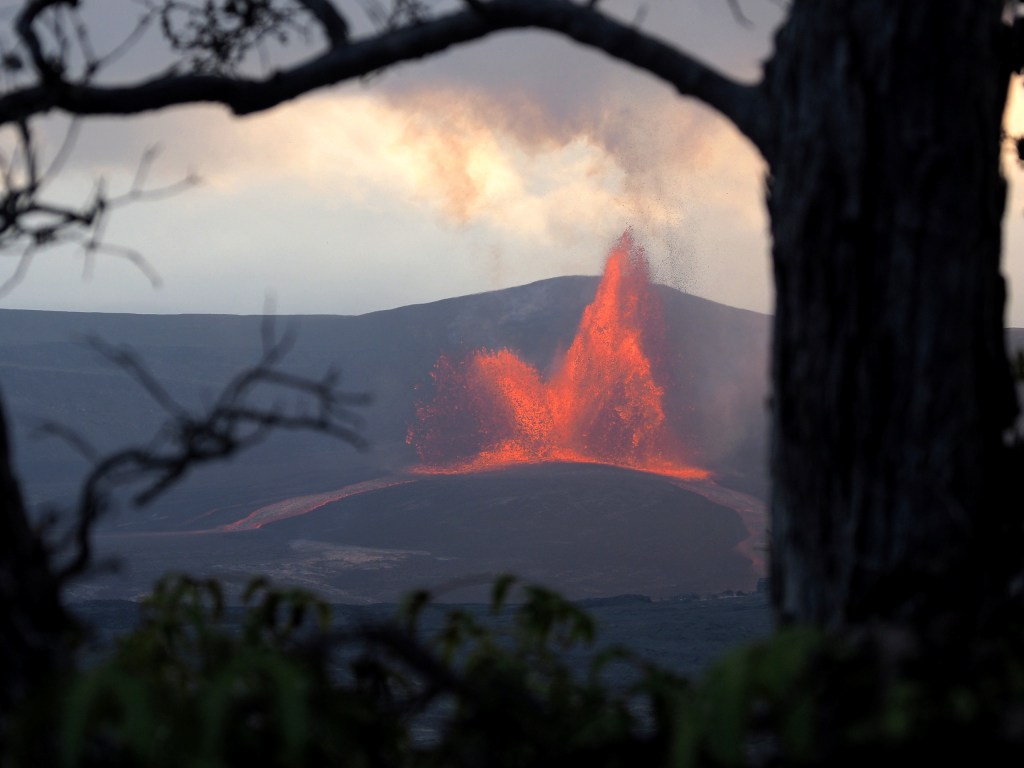
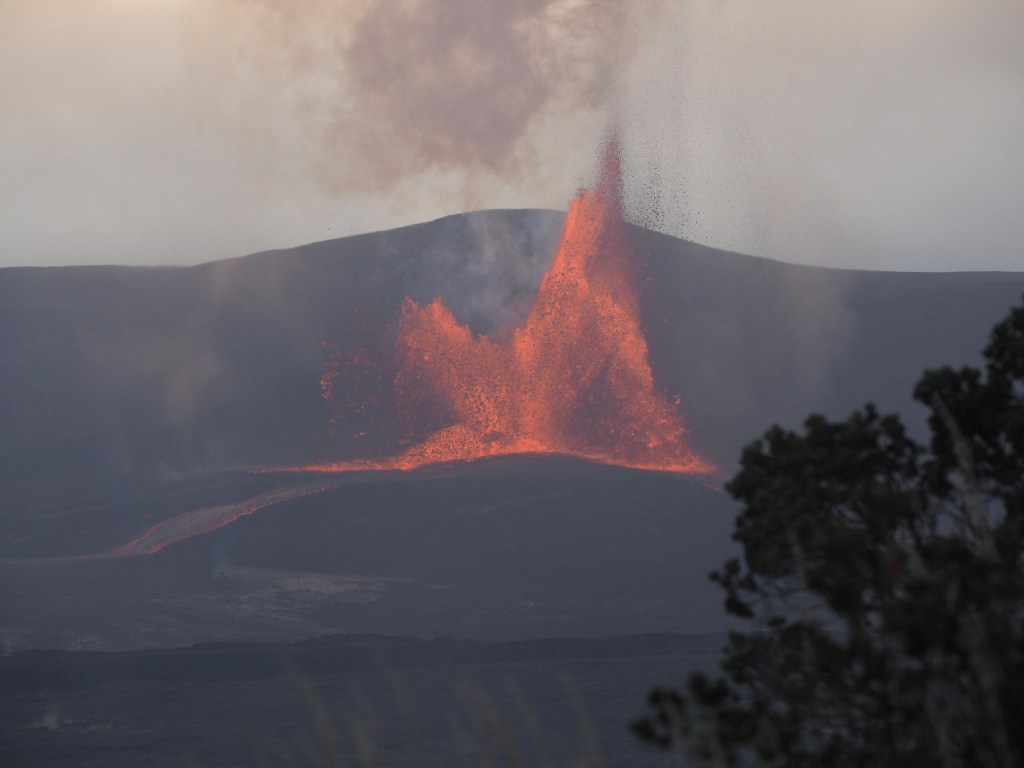


Above is a mosaic of miscellaneous photos.
Above is one of Rosario’s many iphone videos from the Steam Vents area.
There are three main lookouts where there is parking along the north side of the Kilauea caldera rim. The first has the only view of the actual vent when lava comes out, but it is farther from the vent. The closer two lookouts, with rangers answering questions during such eruptions, cannot see the actual vent. But you can hear better and the closest lookout area you can actually feel the heat (not too much).

The map above shows the Park Service’s map of the Kilauea area. The red lines indicate routes to the various lookouts. We did not visit the lookout on the south side, since it took a 1 mile each way walk to get there and we didn’t have time at night to do it. Plus, as we discovered, looking across the extensive lava flows led to a very turbulence-affected view. Plus, the view from Uekahuna was much closer. A Google Earth view of the various lookouts, the current eruptive vent, and our house in Volcano are shown.

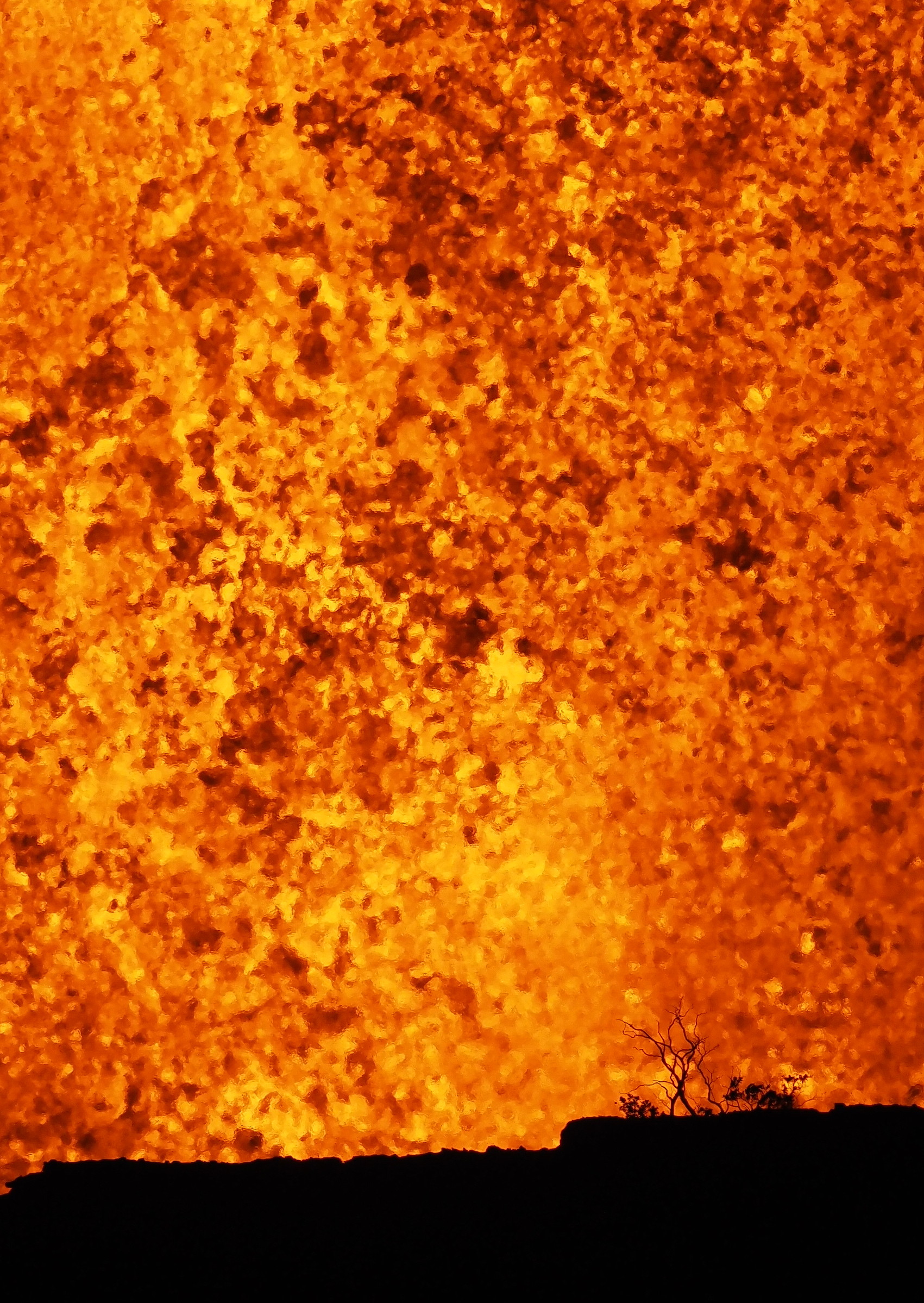
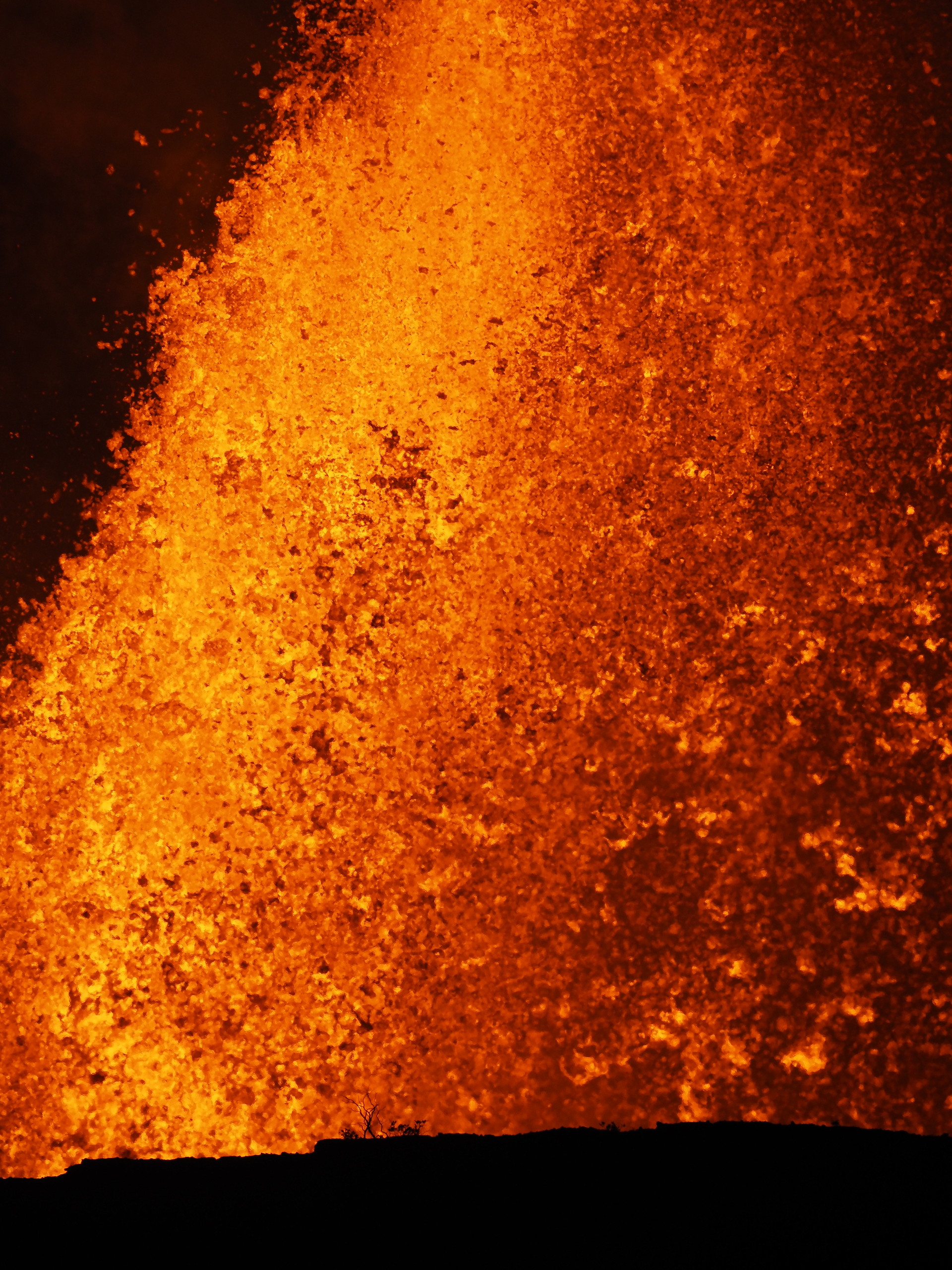
The photos above were taken with a 300mm telephoto – and manually focused on the shrubs on the lip of the inner caldera – perhaps 500 yards away. Mostly too close with this lens for getting the entire fountain in.
Although the eruption was much brighter at night, judging the scale was somewhat harder. We were fortunate to see both day and night parts of the eruption.
The above loop is sped up 10 times (I believe – I sometimes forget to document this, since I can always do it again from the original movie that I took). One can see the foreground better in daytime videos than at night (below, different lens and position).
This is a video of the lava flowing out onto the floor of the inner caldera of Kilauea. This is 10 times the actual speed. I underexposed this video; it appeared brighter to our eyes.
Above is a wider view of the lava tongues – this is also I believe 10 times the actual speed.
This lava river out of the vent, at the base of the fountain, is occasionally sharp and at other times blurry. This is a result of extreme atmospheric turbulence associated with the very hot floor of the caldera.
A telephoto of the side of the eruption fountain showing tephra (pumice/scoria etc)
suspended by the strong updraft.
A somewhat surrealistic movie giving the impression we are very close to the lava fountain.
December 6 2025 eruption
Only about 10 days after the previous eruption there was a stronger eruption lasting about 12 hours and reaching over 1000 ft. Estimates lava output at the peak was near 1000 cubic meters per second. The movie below is speeded up about 18 times actual time to show the inclined plume exiting the main crater. It was due to this very inclined, non-vertical, eruption that the webcam #3 was destroyed. The USGS webcams are placed much closer than people are allowed to get.
A view of the last moments of USGS webcam #3 are shown in the video below, taken from the USGS Kilauea website. I have sped up the animation to 5 times the actual rate.
A normal speed segment of the above video (shown below) shows better the tephra that arrives at the webcam’s location.
The above animation shows a 52 minute period, speeded up about 60 times. Besides the obvious eruption, there are at least 6 vortices, somewhere between a dust devil and a waterspout in intensity, that form just downwind (to the right) of the lava fountain. These are spun-up due to the extreme heat over the area of the lava fountain.
 THE NATURALIST'S TRAVEL PAGE