Reason for our travel
We had visited parts of Argentina various times since 1995. Our camera equipment and techniques have (hopefully) improved and our knowledge of what to expect has obviously increased – but why return again? In part this was tied to our cruise – we didn’t have to pay for a round-trip airfare for both of us to visit Argentina (HAL covered our airfare back to the US). But that is sort of like flying to another country to eat dinner because the food is less expensive there… We always end up spending more than just staying home or flying back from where we get off the ship. So what is the reason we do this?
Insects.
Yes, that isn’t a typo.
We have in the past few years become much more interested in insects – and identifying them via iNaturalist. So we now travel with ultraviolet lights (both battery- and AC-powered ones) and set up our insect mesh with lights every night where possible. In fact, we try to find accommodations where this is feasible. On all nights during this past trip it was possible to do our insect photography – except in Buenos Aires and one night where neighborhood dogs cut our activity short.
Unfortunately, many people have “unfavorable” perceptions of insects (as pests). In addition, since insects are usually quite small, it requires some reasonable photographic equipment to see the details of many insects. Close focusing lenses and flash are essential for good photographs, yet such equipment costs less than the big lenses that many bird photographers have. Smart phone cameras can produce acceptable photos of larger insects like butterflies, but the many smaller nocturnal insects require flash and special macro lenses for detailed photos. And some means to attract insects – their eyes are much more sensitive to ultraviolet light – is also needed. Finally, you need to be out after dark with your UV lights, and this appears weird to many people. Let’s be honest – most people will think you are strange. Of course, they’re right – you are.
A point I like to make to my audiences is that much of the biodiversity on Earth is tied up in insects, together with plants. There are many birders, but relatively few moth-watchers or “insect-lovers”. Yet these are crucial for pollination of most flowering plants. And there are far more types of insects than birds, reptiles, or mammals.
Of course, we are also interested in most nature-stuff, so we do keep our eyes open for various plants (cacti, epiphytes etc.) and flowers (easier to identify to species) and especially what is in the flowers – insects!
Rationale for our route
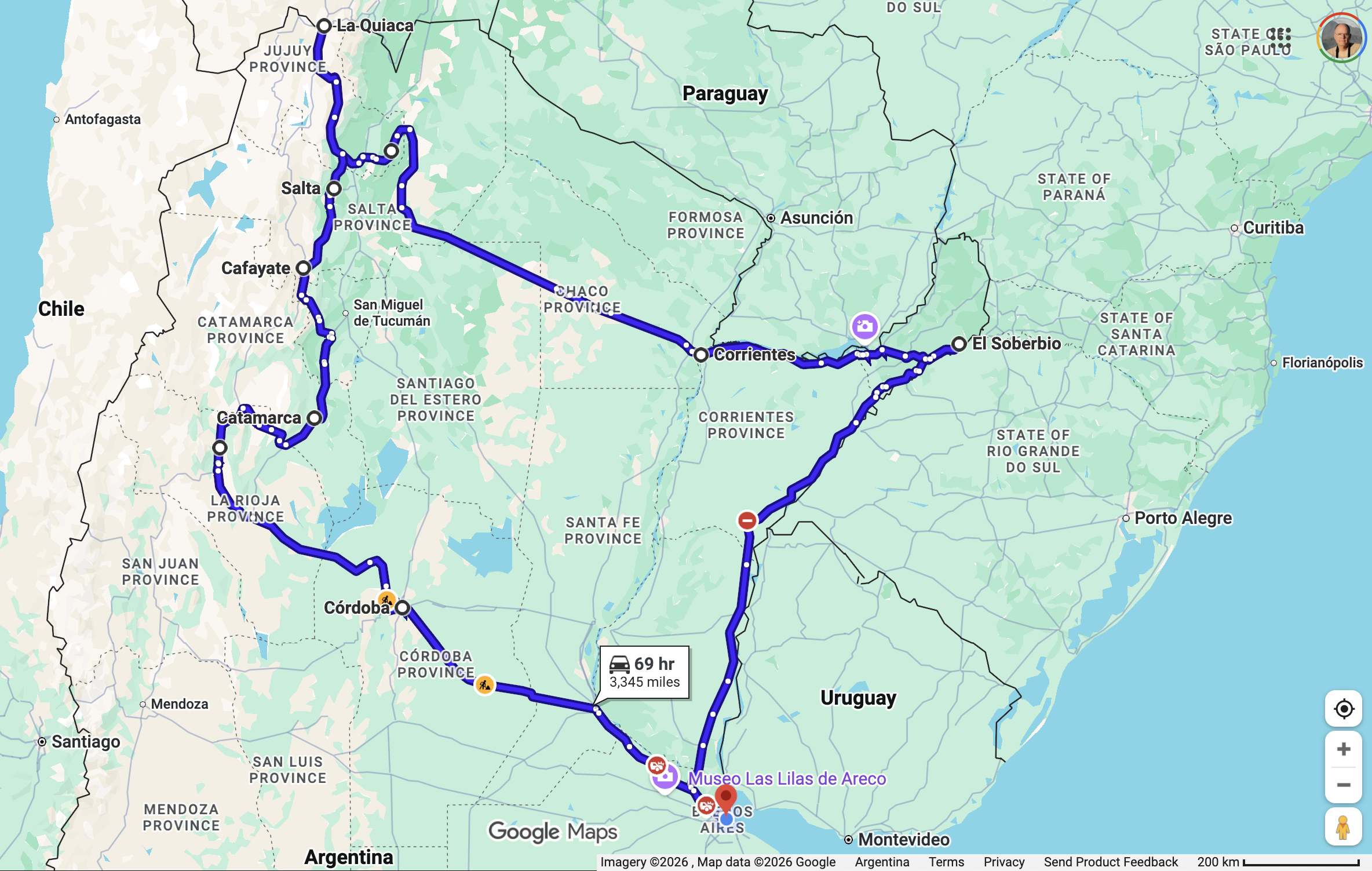
The rationale for this route was roughly as follows. We had never been to the province of Misiones, in the far northeast of the country. This is part of the “Mata Atlantica“, a forested region that is distinct from the Amazonian forest and yet separate from the moist forests along the Andean foothills that we had visited multiple times in the past. The Mata Atlantica extends along the coast from extreme northeast Brazil, eventually becoming broader and extending inland to eastern Paraguay and extreme northeastern Argentina. The best preserved forests of the Mata Atlantica in Argentina are in Misiones, and much of the surrounding Paraguayan and Brazilian forests have been deforested over the past 40 years.
While the best remaining tracts of forest lie near the Iguazu Falls area in Argentina and Brazil, driving there would have added several hundred extra miles and it wasn’t clear that the additional costs and access would have been better. We decided to visit the forest reserves just beyond the town of Soberbio, along the Brazilian border instead.
Deciding to visit Misiones also allowed us to visit the Parque Nacional los Palmares, a place we had visited some 30 years earlier. Our experience then was in winter – it was cold and the road being dirt was not really suitable for our vehicle. In recent years on international travels we have usually opted for 4-wheel drive vehicles with substantial cargo space. these are substantially more expensive, but we travel with much equipment and the high clearance and 4×4 capability with low range – though rarely needed, gives us peace of mind in pulling off the road, or crossing shallow streams or muddy stretches. With low-clearance vehicles you have to turn around (can be a very long detour) or risk getting stuck.
The main drawback to our plan to visit Misiones was that it forced us to drive across the trans-Chaco highway to get to the Andean areas. The Chaco is a flat, relatively uninteresting landscape with short trees and now with lots of agricultural development. Not very exciting 400 mile drive. And we discovered, the road conditions were as bad as we remembered from many years earlier. Frequent potholes, fractured roads (where concrete) and undulating, truck -beaten, surfaces where it was asphalt. Traffic was not heavy, but the entire route required careful driving to avoid potholes and bad pavement stretches. The trans-Chaco highway is one lane in each direction, with very few dedicated passing lanes. Not great for a mix of slow trucks and fast cars.
We had hoped the drive back across the Chaco from Cordoba to Buenos Aires was going to be much better – it was 2 lanes each way and looked OK on Google Street view. Unfortunately, maintenance has decreased during the past two years due to national austerity measures and many segments of this 400 mile drive were in questionable condition. We discovered this situation in some respects was similar to that seen on major highways in Germany. There trucks much stay to a 80 or 90km/hr speed limit while other vehicles can go 130 km/hr (probably more in Germany). Thus, the right lane has lots of slow trucks (80km/hr is about 50 mph) and the fast lane has cars wanting to go the speed limit of 130 km/hr (about 80 mph). Now add the factor that the right lane was nearly always in worse condition (due to the heavy trucks) than the left lane. So we tried to stay in the fast lane as often as possible – all the while looking in the rear-view mirror to see if very fast cars were approaching (since we were driving near 100km/hr). So our drive on this freeway was a near constant back-and-forth changing lanes to minimize the pummeling of the bad right lane. Hardly a relaxed freeway drive. Ah, forgot to mention that this wasn’t strictly a freeway for much of it – it was a toll road – but the tolls were very low – usually 1-2 dollars for long stretches. Clearly not enough to maintain the highways (and in fact we almost never saw roads being repaved in our nearly 4000 miles of driving).
This map shows our route compared with all of Argentina:
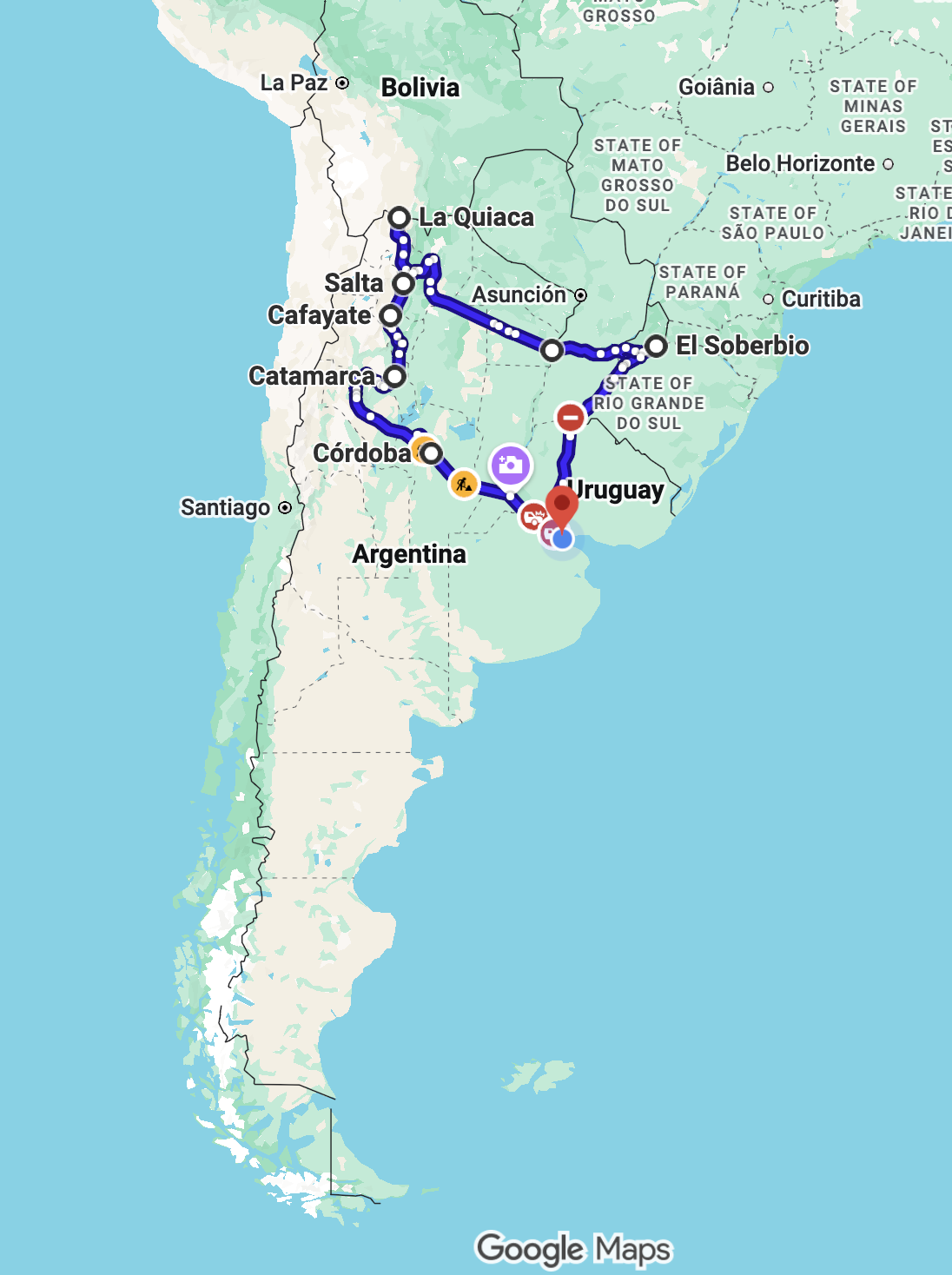
As you can see, we have ignored most of Argentina.
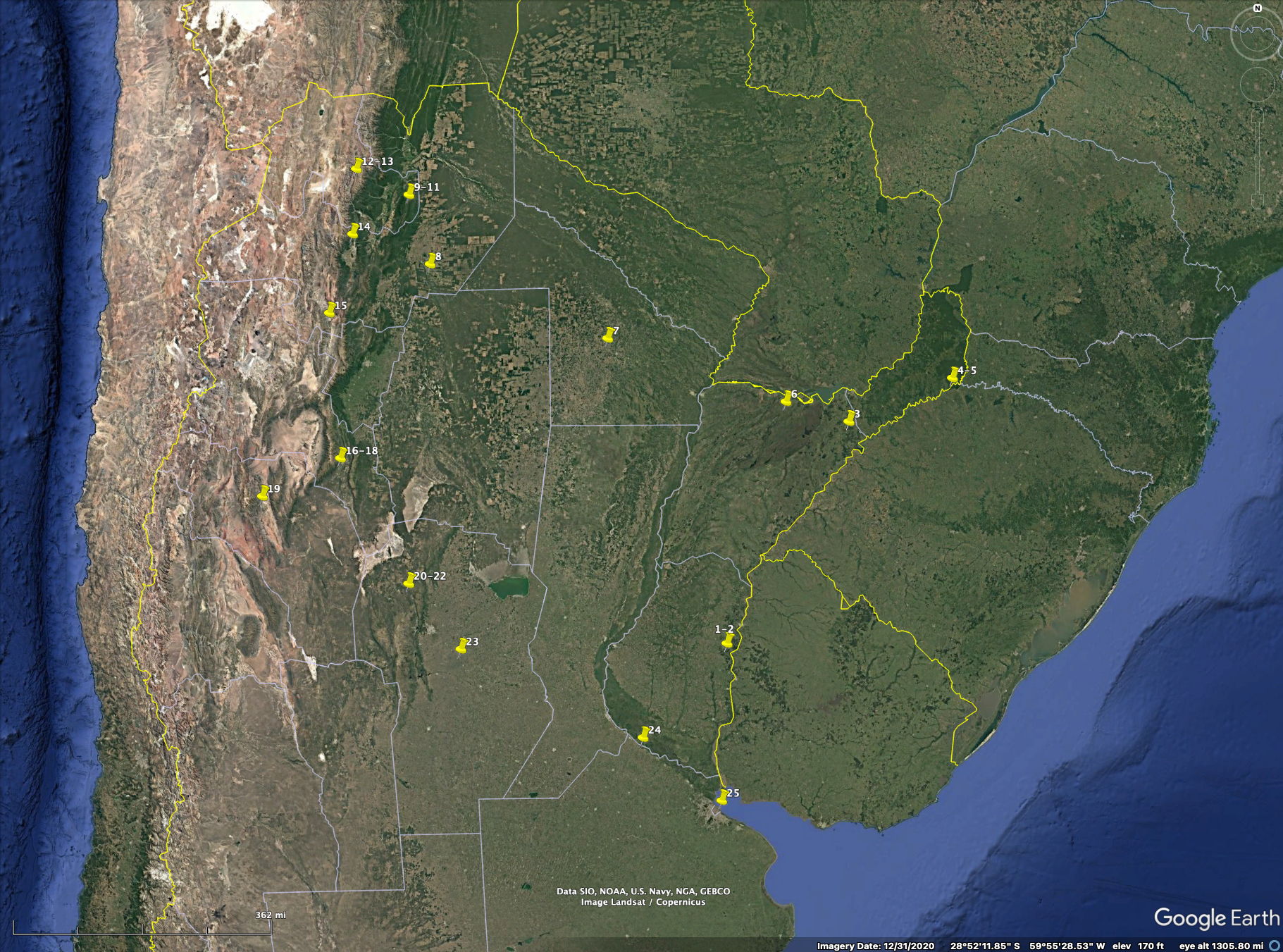
The above map (and those below) show where we stayed each night during our trip. The numbers indicate the night. The numbers towns are: 1-2) Parque Nacional El Palmar, 3) Gobernador Virasoro, 4-5) Mision Mocona 6) Ibera Birding Lodge 7) Hotel El Rebenque 8) Hotel Don Alfonso, 9-11) Ecoportal de Piedra ,12-13) Tilcara, 14) Salta, 15) Cafayate, 16-18) Monte Zion, 19) Chilecito, 20-22) San Marcos Sierra, 23) Oncativo, 24) Ramallo, 25) Buenos Aires
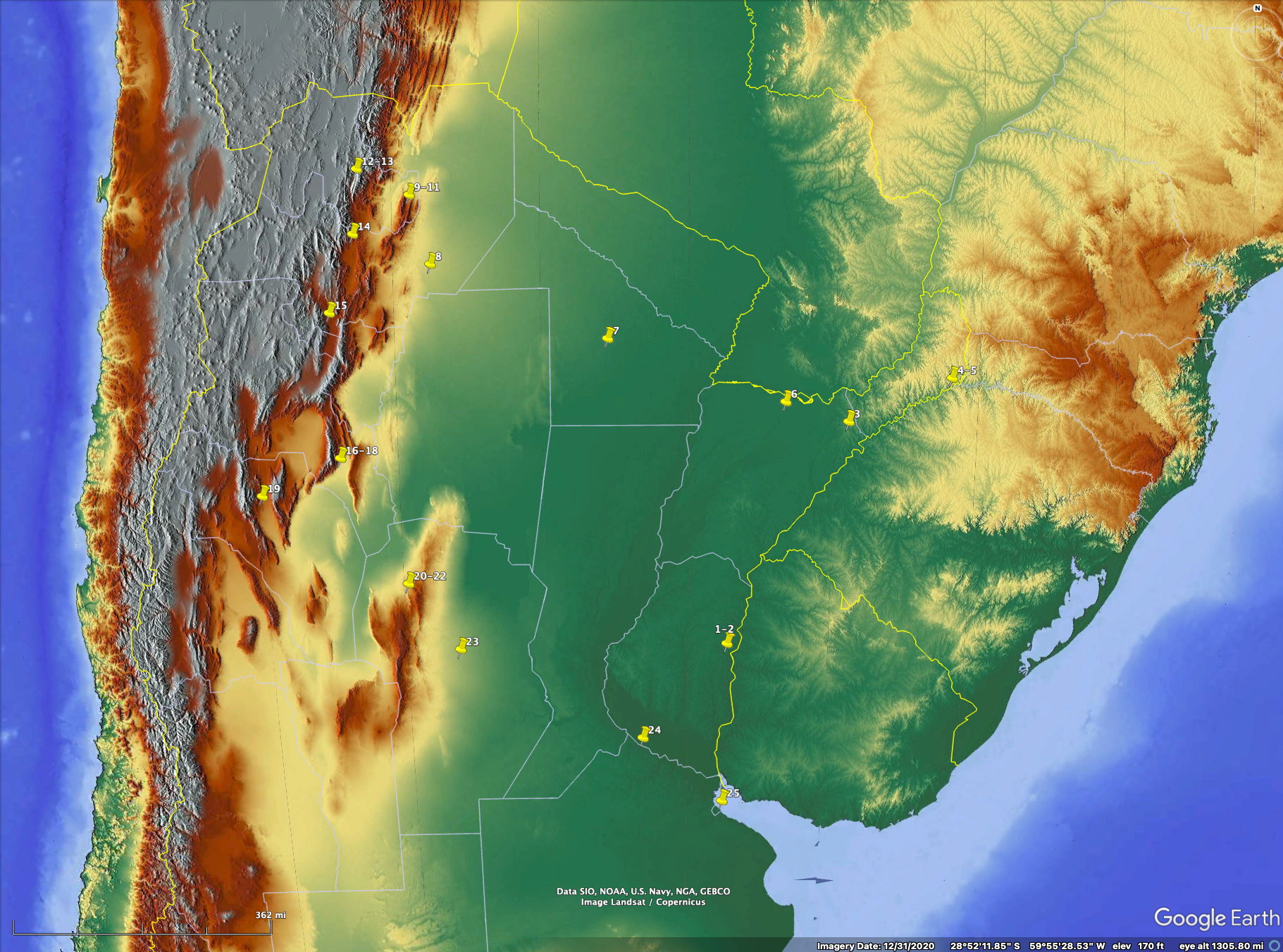
The above maps show that the Chaco (7,8) is very flat compared with western Argentina or extreme northeast Argentina (the Misiones Province) that merges into high terrain in southeastern Brazil.
 THE NATURALIST'S TRAVEL PAGE