See this link for a talk on the natural history of the southwest corner of Australia. It has a mostly bird-focus as it was prepared for an Audubon talk in Norman, Oklahoma. Eventually, this section will have much more material related to the natural history of southwestern Australia.
Southwestern Australia was to us perhaps the most novel of almost any place we have ever visited. As seasoned natural history travelers we usually do considerable planning in advance of our travels. We thought we had done some for Australia, but when we started exploring southwest Australia we were very surprised. There were times we were in the field, looking at plants, and we could not identify anything we saw – to the nearest plant family. We were botanically lost. And the flora is spectacular – not only the flowers but the leaf forms and the wide array of insectivorous plants in habitats we could not have possibly predicted.
Southwest Australia, bordering the Indian Ocean, has a Mediterranean climate with winter (cool season) rains and dry summers. But this varies with distance from the ocean, with inland locations being much drier and warmer in the warm season and cooler and drier in the winter. Though the terrain is generally low, a few isolated mountain ranges extend to above 3000 ft – enough for rare winter snows.
There is sufficient rainfall to support forests near the coast and some of the largest trees in Australia are found here. But these have a very small geographical extent and much of the southwest is shrub land – much like coastal California chaparral or South African fynbos.
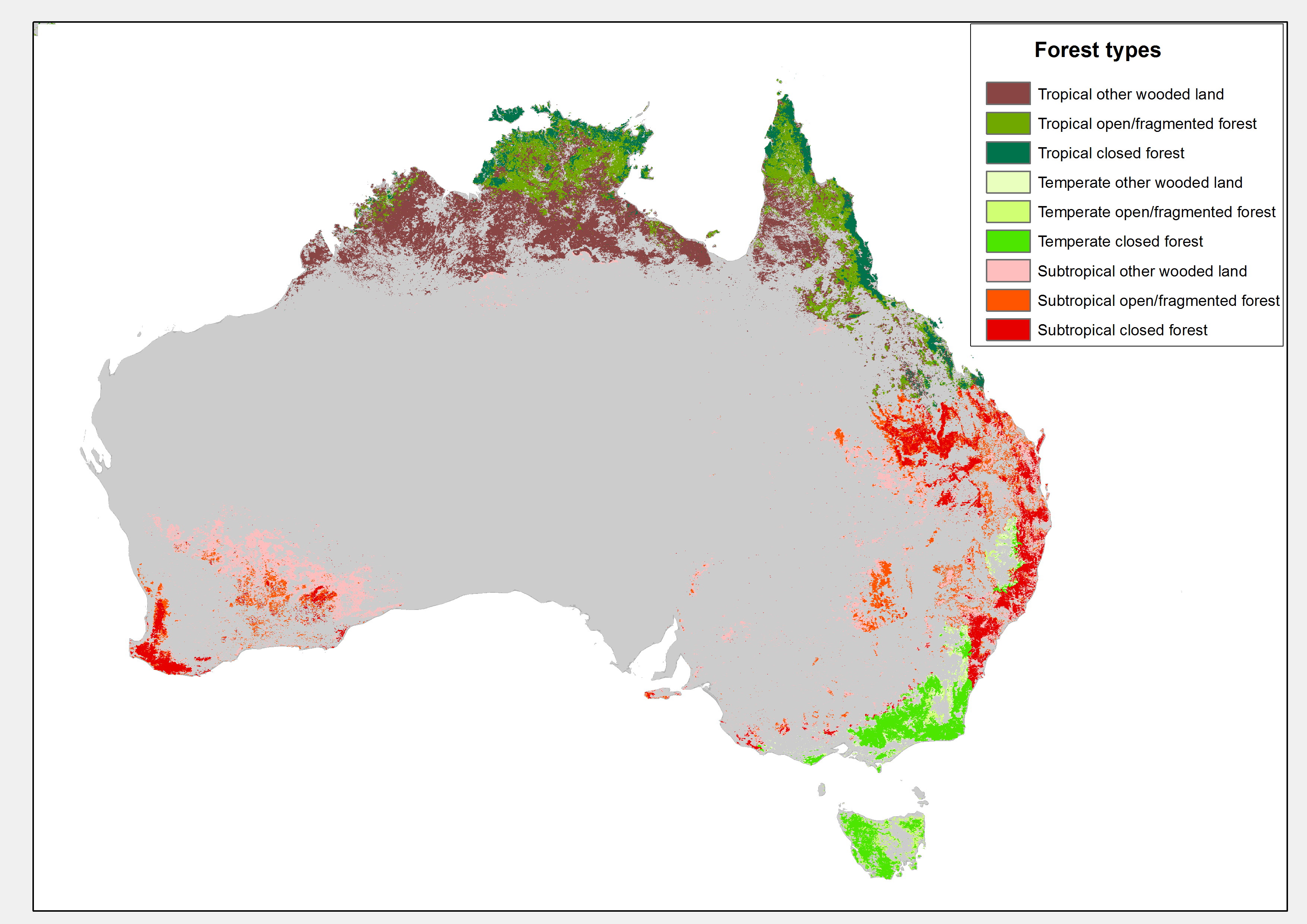
The lack of tall trees in many parts of Southwest Australia is evident from the map above. In the southwest much of the forest has been converted to agricultural lands. The shrub lands are the main attraction here. The structure of leaves and flower forms are very diverse and many are unlike those seen anywhere else in the world.
Why Southwest Australia is unique
Part of the explanation for why the southwestern corner of Australia is very different from the rest of Australia and the world has to do with its isolation. The moister region, with winter rain, is isolated by dry regions to its north and east, and by the ocean to the west and south. The region is effectively a biological island, similar in many ways to the Cape region of Southern Africa. This isolation has led to the evolution of many life forms that are different from other parts of Australia. Some of the uniqueness can be seen from examining iNaturalist maps.
Approximately 20 species of birds are also endemic to SW Australia, and many other vertebrates.
A page dedicated to a trip to the SW corner of Australia, after a cruise that ended (for us) in Perth is here.
 THE NATURALIST'S TRAVEL PAGE