Based on lecturing experience 12 HAL cruises since August 2022 (and one personal HAL cruise to Antarctica) the following comments are offered to enhance the experience of cruisers who travel to see aspects of the natural world.
Although I have broken down cruises by geographical regions below, all suffer from similar problems with presenting suitable material for nature-oriented travelers.
Holland America cruises cater to older passengers with more time (and financial means) available to them. Perhaps 10-20% or more of the passengers have significant mobility issues and cannot, or don’t wish to participate in shore excursions or tendering operations. Another, possibly similar percentage, have no strong interest in seeing the destinations – they are cruising because life aboard ship is better that staying at home and the socializing activities are better onboard. Thus, perhaps only half of the passengers have interest in the destinations, and of these, only a fraction, varying with the cruise, have a genuine interest in nature-related subjects. That is reality – I wish it were different – but it is what it is.
Amazon cruises
Amazon cruises generally stop at the same ports during each visit. Although there are approximately 9 days spent along the Amazon (depends on where you define the start of the Amazon) there are 6 port days in succession. This makes “river-day” talks not as effective as they might otherwise be, since feedback from a day’s shore excursions won’t reach the audience until many days later. There is also insufficient time to cover nature-related possibilities in upcoming ports.
Perhaps this needs more clarification. Port excursion talks and EXEC-type talks don’t generally cover nature-related topics. The staff presenting such talks don’t have sufficient background in these subjects (most such individuals tend to come from tourism, hospitality, or various entertainment backgrounds). And evening times in the World Stage are reserved for entertainers or special groups such as a Brazilian or Polynesian Troupe that comes aboard for a longer cruise segment. As it stands now, if something important or interesting (that should be brought to the attention of passengers) is seen on the first port visit up the Amazon, they will have to wait until after the 6th port stop to hear about it.
As a more general comment, and one that applies equally to the Antarctic cruises, is that these cruises are advertised first and foremost as “Amazon” or “Antarctic Experience” cruises. That is what they are sold as. Why then is information and knowledge about these destinations relegated to second tier status compared with most other activities aboard? A cruise is to see and experience other parts of the World. It is not the same as a Las Vegas Resort Hotel, nor should it be.
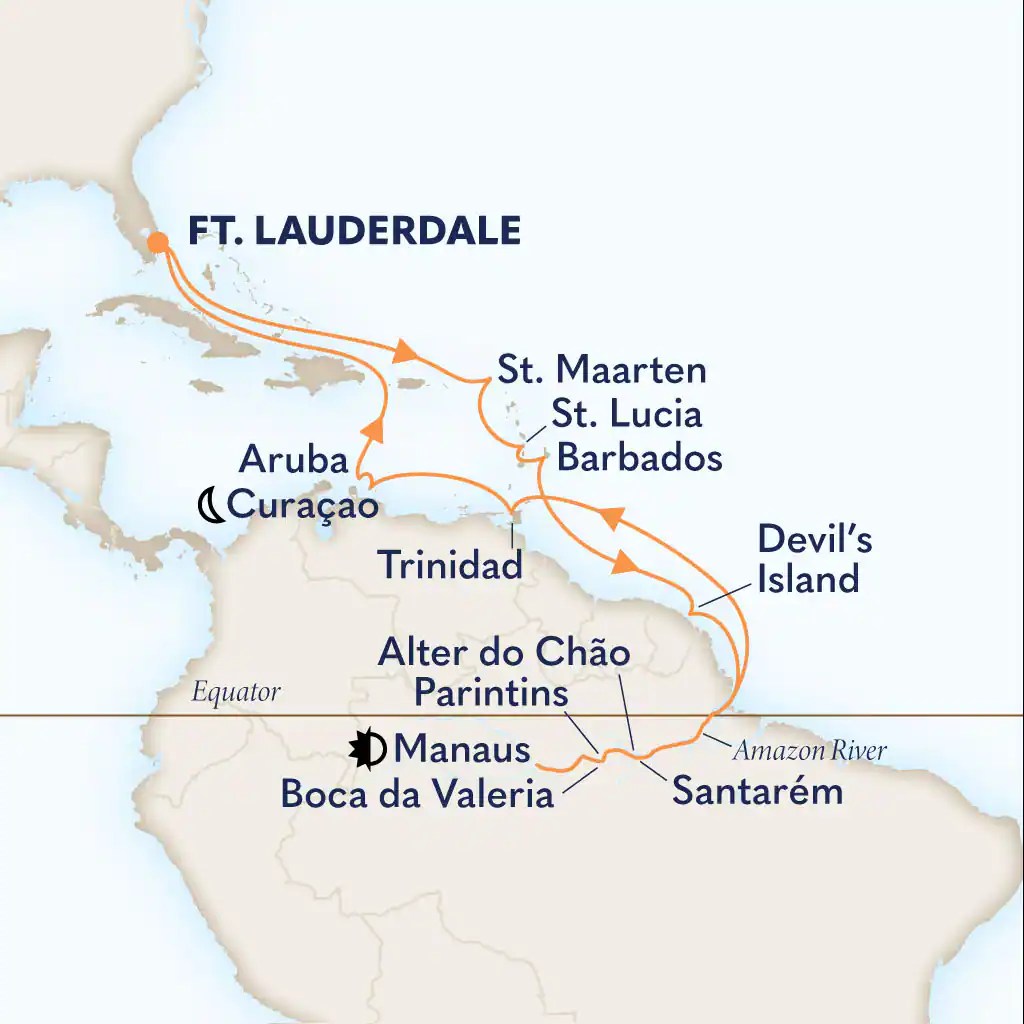
Specific improvements I suggest for Amazon cruises include the following.
1) Adding plaques on the promenade to explain features the passengers will see along the river – and on excursions. These should be changeable from cruise segment to cruise segment. When the ship is crossing the Caribbean different plaques can be displayed from those shown along the Amazon. Why the Promenade? Because many (perhaps most) passengers will never go to a guest lecture, and such lectures might not even be focused on the nature of the Amazon Basin. There are many conflicting activities aboard the ship and the plaques can reach people who would otherwise see or hear very little about the nature along the route. (I am investigating possible sources or contributors for such informational plaques).
2) Providing short talks and question and answer sessions in a smaller room (ideally 100 PAX capacity) on port days. This might best be scheduled in the time slot after the first World Stage show and ending just before the second show. This would typically be 8:15-9:00 PM. Perhaps 8:20-8:50 PM would accommodate passengers wanting to see either show time. Of this 30min slot, perhaps 10 minutes would be for Q&A and 20 minutes dedicated to presenting what was seen that day and what the next day would have of nature-related interest.
3) Providing an ultraviolet light set-up on the promenade where moths and other insects will be attracted to at night for passengers to conveniently see and photograph. This is most easily done on the stern and depending on the ship, on the topmost deck (weather dependent) in a wind-protected area. Also, during the ship’s traverse of the Amazon, it should be requested that the crew not wash down the sides of the promenade and only minimally wash down, as essential, the promenade deck itself. Many of the insects that alight on the promenade will remain there after daylight, if not disturbed. No salt-water deposits needing cleaning should affect the ship during its traverse along the Amazon.
While insect-watching might seem a bit much for many cruisers, I would argue that it will be the highlight of the entire cruise for many other passengers. Seriously. Read our summary of the Amazon cruise and its insects that we prepared here. Or just glance at the photos we took of the several hundred species we have identified with the aid of the iNaturalist application.
Antarctic cruises
Antarctic cruises for larger cruise ships generally follow similar paths to those of Holland America, so I use here a HAL example of the most common track. Such cruises start in Buenos Aires, Argentina and end in the port of San Antonio (the main port for Santiago, Chile). The itinerary is shown in the map below. There are 4 days out of 19-22 days in the cruise spent around the Antarctic Peninsula, and HAL terms this the Antarctic Experience. They bring a special group of polar specialists aboard to provide talks during this segment of the cruise. Several comments are needed about our experience on one cruise to Antarctica with HAL.
First, our speakers were clearly knowledgeable and spoke with passion about their subjects. No problem here. This was a team from New Zealand.
Second, not all sea days had talks, with the approaches towards Antarctica and returning up the Chilean fjords lacking talks on some sea days.
Third, the talks tended to be on somewhat specific subjects, and didn’t cover some important generalities for a first-time cruiser going to Antarctica in our opinion. More information about icebergs, pelagic birds (no bird-savvy person was on our team), and some basics of how penguins feed and move through the water would have been welcomed. Many people, including ourselves, had never seen penguins moving through the water (a porpoising-like behavior) and initially did not appreciate they were penguins when seen from a distance. The diversity of pelagic birds around Antarctica was never stressed yet these were the “wildlife” most often seen and often were present in abundance.

Some oceanographic concepts would have been useful, including the importance of offshore katabatic winds in keeping water open around parts of Antarctica, leading to the formation of sea ice and very dense ocean water that is crucial for deep ocean circulation.
There were sea days without talks, where additional material could have been presented about Patagonian flora and fauna (especially prior to Puerto Madryn), and about the unique southern hemisphere forests that might be seen around Ushuaia, Punta Arenas and Chacabuco. Again, people ought to be paying to hear and see what is unique to this part of the world, not to see dancers and comedians they can see on any cruise. Our biased opinion.
Caribbean Cruises
There are innumerable cruises throughout the Caribbean Sea region, both by HAL and many other cruise lines. Most are intended to fill the need by working individuals to take a vacation no longer than one-week. These can be put together to make multi-week trips, but they all tend to return every week to either Miami or Ft Lauderdale. Most such cruises have 2-3 sea days, with 2-4 port calls. The passengers are perceived to be in a relaxation/party mood and talks by guest speakers are uncommon (I have no personal experience on these cruises). Thus, perhaps the largest market for cruise passengers has no access to information about the natural environments of the ports they will be visiting in the Caribbean. At the minimum, some plaques about the pelagic birds, geology of the islands, or maps of the islands to be visited, would perk passenger interest in seeing what is ashore.
The cruise shown below has six (6) straight port days. How would passengers learn about anything natural (or even cultural) prior to their next port visit?

Western Mexico Cruises
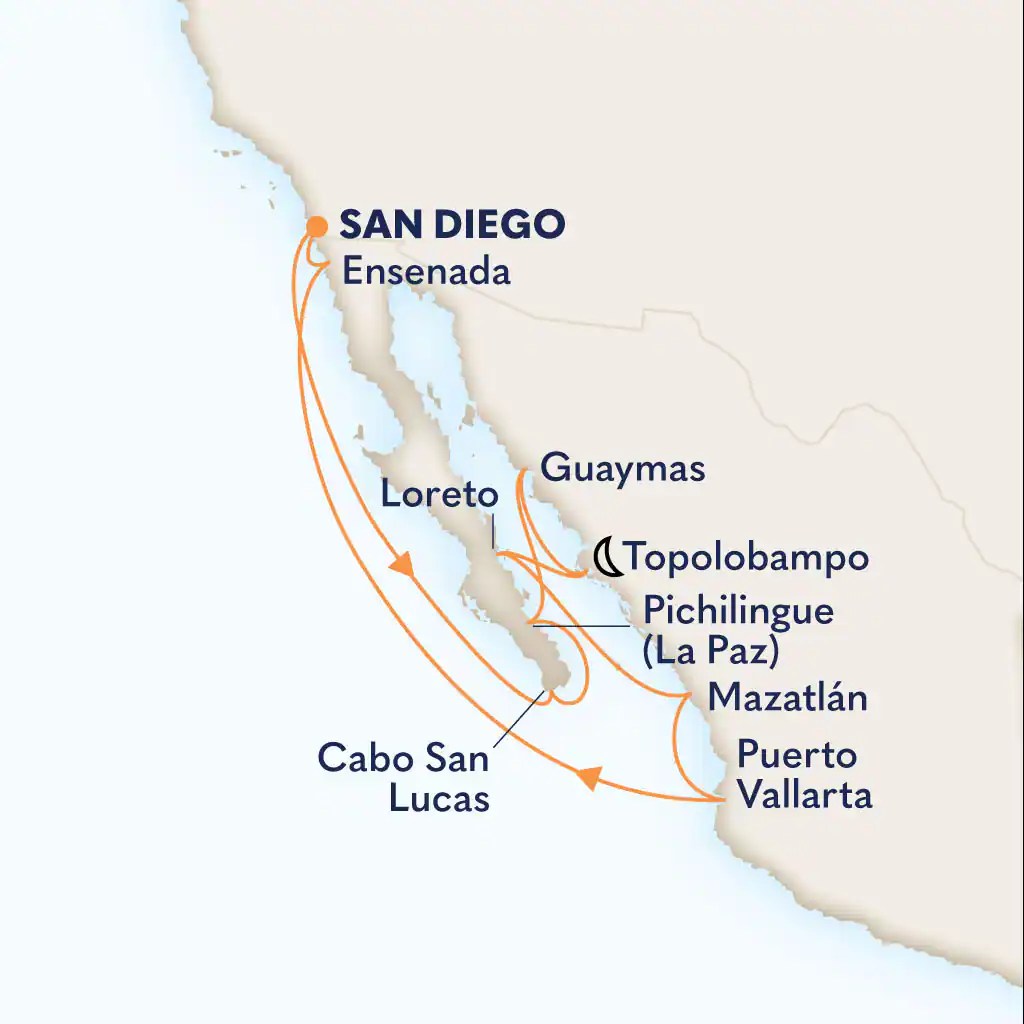
A particularly egregious example of successive ports can be seen in cruises that visit the Gulf of California as part of a western Mexico cruise from San Diego. On this example (seen below) there are seven (7!) consecutive port visits without a sea day between. Such cruises would clearly benefit from evening talks about the upcoming port and surroundings. Likewise, some informational plaques would be useful in explaining what passengers might see while cruising the Sea of Cortez and nearby Pacific.
Alaskan cruises
Most Alaskan cruises have relatively few sea days and so sea-day talks are not particularly useful. Here promenade plaques or evening summaries of the day’s shore activities would be useful. Unfortunately, evening talks would still be when the sun was up and some passengers might want to be looking out rather than listening to a talk – albeit short.
Mediterranean cruises
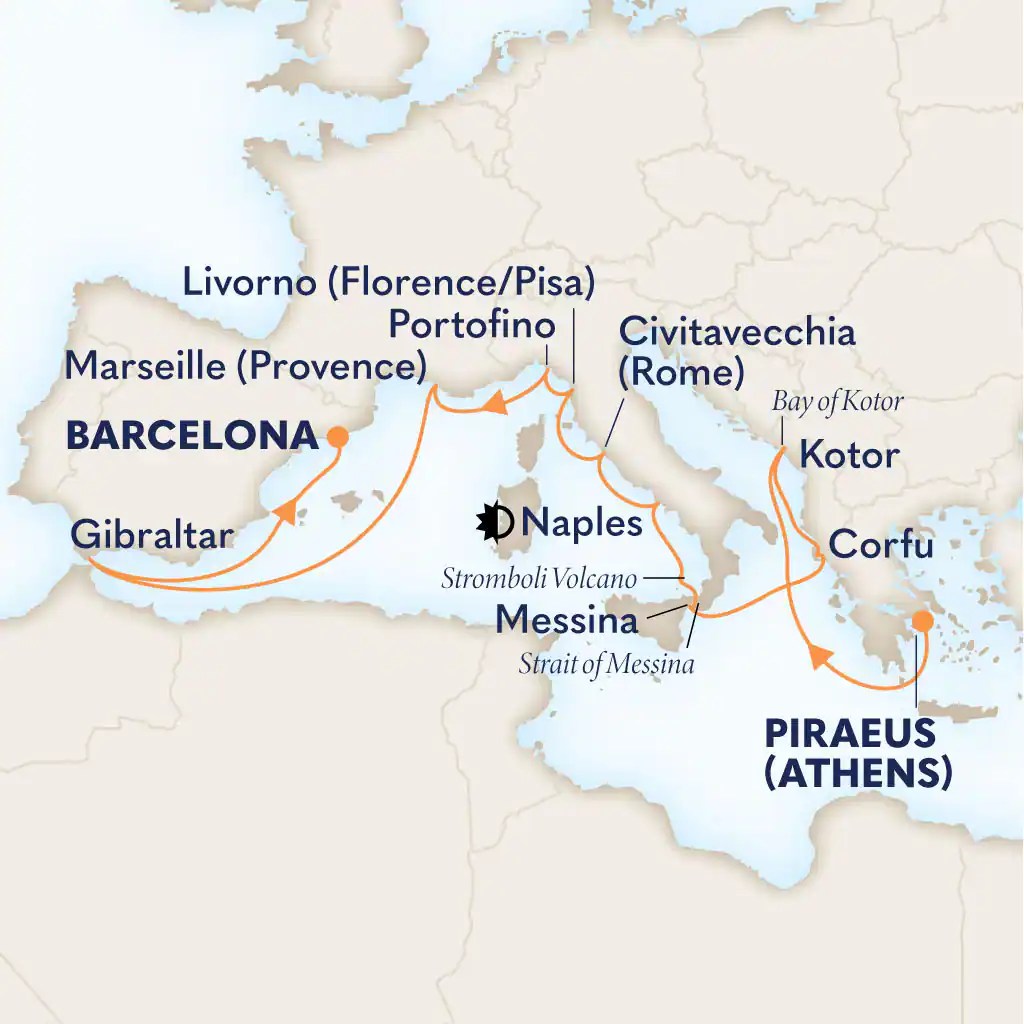
Cruises through the Mediterranean would obviously benefit from cultural talks that focus on the destinations. But again, there are usually relatively few sea-days to justify speakers. However, an evening discussion of nature-related topics about the Mediterranean (volcanoes, earthquakes, the origin of common foods etc.) could be justified in a smaller room. The cruise shown below has 9 port days in succession! When does the Cruise and Travel Director give port talks about each of these ports?
Hawaiian Cruises
Some cruises that visit the Hawaiian Islands can benefit for daily nature-related talks on port days. An example is shown below, where there are six (6) consecutive port days without a sea day between them. As with the other examples above, this prevents feedback to the passengers about what they have seen and a fresh reminder of the next day’s possibilities. One example is shown below.

While there are many sea days to and from Hawaii in the cruise example above, the material presented on these days will be hard to remember for most passengers – especially any details about specific islands – that come in quick succession once the islands are reached.
Supplementary low-cost additions to increase cruiser “awareness”
Plaques on the promenade or elsewhere on the ship. These could be sponsored by small corner ads by those funding the plaques. Examples might be by Cornell’s Laboratory of Ornithology, National Wildlife Federation, The Audubon Society, the World Wildlife Fund and the International Biogeography Society – among many other possibilities.
Videos could likewise be funded, or modified from existing videos, relevant to cruise destinations.
Finally, prepared short talks on nature-related subjects tied to the ports of call and cruise routes could be produced by lecturers or by others ashore. This might be the simplest addition to the onboard TV selection menu.
Videos about nature-related subjects on the Ship’s TV channel
Short videos could be prepared and made available via the ships internal TV network. Some simple topics are below – literally hundreds could be prepared about nature and science topics.
Cetaceans
Weather and climate 101
Google Earth and its imagery
Oceanic conditions (swells, currents etc)
Unique Tropical vegetation (palms, mangroves etc.)
Pelagic birds
Citizen Science apps
Sea ice and icebergs
Weather Forecasting 101
Coral Reefs and atolls
Space exploration
Environmental issues in the tropics
Dedicated naturalists on select cruises
A cruise line like HAL currently supports bridge, dance, creative writing, exercise, tech support and a handful of other individuals to participate on cruises. Why not a naturalist who would, in the same theme as a Road Scholar program, provide dedicated talks to a paying subset of passengers aboard? These could be held in the evening of port days, or in the mornings of sea days, and would complement any sea-day talks that the naturalist might give to a larger (World Stage) audience. Such port-day talks wouldn’t be held hostage to the prime-time performers on the World Stage, and could be held simultaneously in the evening. In this manner, the naturalist could be supported financially by the fee for attending the talks. This would enable many more speakers from the natural sciences to participate in cruise lecturing.
 THE NATURALIST'S TRAVEL PAGE